
How Flames Go Out
reflections on a workshop about burnout in ministry from R2 2024.
 By Emmanuel, 7 November 2026
During R2 2024, Dr Tasha Chapman conducted a workshop titled “Burning On Not Burning Out”, about how we can maintain a lifetime of ministry. There, she outlined the practical things we can do in order to prevent burnout in ministry. Dr Chapman was part of a research team that looked into the reasons for burnout in pastors where she not only learned about the intensity of a pastoral role but also about the human condition. I found myself examining my ministry again as I looked back on the workshop; reminding myself of the important habits that I might have neglected. I have been serving in different student ministries at different capacities for over 8 years and there were times that burnout has been a possibility. This reminder has been a real breath of fresh air for me. Here are my thoughts.
The key to building resilience
We often harbour a lot of preconceived notions when it comes to ministry. Some people feel like ministry work should be very intense and some would look at the fruits of their labour as the most important aspect to ministry. Whether or not we think of these notions as true or healthy, we cannot help but come back to them from time to time. What should ministry actually look like? I think the truest answer lies in the purpose for ministry itself. Ministry should look like what God intended it to look like. But knowing that does not erase the expectations coming both from ourselves and others.
The key to building resilience in ministry, said Dr Chapman, is to increase your self-awareness by accounting for your whole being intentionally. So our ability to recover from challenges and remain adaptable comes when we know where we are holistically.
Self-stewardship
Dr Chapman introduced the idea of “self-stewardship” where we look to take care and manage our whole self (emotional, mental, intellect, etc.) in order to “run with endurance the race set before us” (Hebrews 12:1). The act of caring for our personhood allows us to do ministry well. In ministry, like in any people profession, our health impacts all others around us. Thus, self-stewardship is deeply important in ministry. During the workshop, Dr Chapman challenged us to consider how Jesus did his ministry. There were times he rested (Mark 4:37), there were times he stopped to care for others (Luke 8:43-48), there were times he disappointed people (Mark 3:20-33), there were times he paused to pray (Luke 5:16). Jesus self-stewarded his ministry well.
What struck me was how Jesus disappointed people. He was so aligned with God’s will that he knew what expectations placed on him were misplaced. Sometimes not all things that are helpful are what God wants of us. That requires discernment and wisdom because there are also expectations that are aligned to God’s will. I must admit that I personally find it hard to say “no” to people in ministry. I find it hard to let people down especially when I know I am needed. But that is unsustainable and sometimes unhelpful. Upon more reflection I can sometimes accept things just because I want to be known as dependable. It is good to be dependable, but it is also easy to forget that we serve God and not ourselves. Self-stewarding for me is to know when I am sacrificing myself just to please others and not God.
Cultural narratives
Another concept Dr Chapman introduced was to measure our cultural pressures and stories against the truth of the Biblical metanarrative. The Biblical metanarrative is the overarching story of the Bible and the gospel. It comes in four parts: Creation, Rebellion, Redemption, Restoration. The cultures we live in shape so much of our lives. Dr Chapman describes them as the air we breathe and the hidden map of how to do daily life; it is so essential to who we are yet we do not notice it. So when we do ministry, we must be aware of the culture we live in – the stories they tell of work and rest. These stories might be good and shaped uniquely by God or they might be harmful and sinful. So we must measure them up to the truth, that is neatly placed into the Biblical metanarrative.
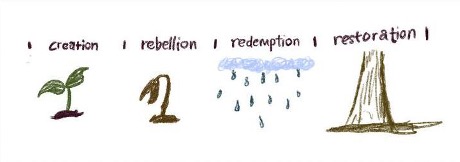
The Biblical metanarrative that plays out across the Bible.
What cultural stories do we tell in Singapore? One of the main things I missed whenever I travelled abroad is how convenient things can be in Singapore. In almost all residential areas, food and groceries are never too far away, trains stretch throughout the country and buses are generally well connected. Convenience has worked mightily for us in Singapore. I think it translates quite literally to our cultural narrative. We want to be efficient and we don’t want to waste time. “Waste time lah” is literally in our vocabulary! So when we work we put a lot of value in how we are spending our time. I find myself constantly asking if the thing I am fixated on is useful or enriching.
Now we measure it up to the Biblical story. As fallen, rebellious creation, we are limited and we are needy. We cannot be perfectly efficient and useful. If we place such unrealistic expectations on ourselves to be constantly useful, we forget the fact that we are fallen and in deep need for God’s grace and mercy. However, there are also parts of that story we can affirm. It is good to strive to be excellent and not to be wasteful with our time. But there comes a point where we have to be gracious to ourselves in times where we don’t measure up to our expectations. There also comes a time where we need to acknowledge that we can only do our best and offer that up to God.
Conclusion
When I look forward to the ministry work I have yet to do, it fills me with both excitement and dread. There is always a lot to do and there is always a need, but to sustain our ministries for the long run, we need to steward ourselves. As we become more aware of our needs and desires and frame them from our cultural lens in the wider biblical story, we can start to be more reflective and learn to live more balanced lives. Ministry work can be draining especially when we give ourselves to care for people, but we are not alone, our God will be with us always.